
Persona Blocks
Persona Blocks
Pre-Seed · 2026

Identity is
infrastructure.
Not a honeypot.

Persona Blocks is the sovereign KYC platform where users own their verified identity — encrypted end-to-end, controlled by their wallet, and compliant by design.

Morris Mwanga · Founder Yale School of Management dev.personablocks.io
Press → to advance
The Problem

The identity system costs
a fortune — and still fails.

$206B
Global KYC compliance spending annually
$30–$300
Bank cost per customer onboarding
850M
People locked out — no government ID
15%
Annual growth in KYC compliance costs
Some Recent Incidents
🏦
IDMerit — Identity Verification Platform Nov 2025
MongoDB left open to the internet. The entity hired to verify your identity could not secure its own database.
1B records
📊
Equifax — National Credit Bureau Sep 2017
SSNs, DOBs, addresses stored in plaintext. $575M FTC settlement.
147M records
🧬
23andMe — Genetic profiles Oct 2023
Irrevocable biometric data. Breached and sold.
6.9M records
📋
MOVEit — File transfer vendor Jun 2023
Single supply-chain attack. 2,500 organizations exposed.
62M records
Root Cause

Every company collects
the same data — independently.

The current model forces every service provider to store a full copy of your most sensitive data. Each copy is a honeypot. N honeypots = N times the risk.

The Current Model

  • Bank, fintech, airline, hospital all collect your passport — independently
  • Each stores a full copy with its own (often poor) security posture
  • 10–20% of onboarding applications abandoned due to friction
  • Average breach cost: $4.88M per incident (IBM 2025)
  • Age check → full background investigation you never consented to (Persona, Feb 2026)

What Sovereign Identity Changes

  • Verify once. Present a cryptographic proof everywhere else.
  • No central database — nothing to breach at scale
  • User consents to each disclosure, per attribute
  • Revocation is instant — one on-chain transaction
  • Compliance is built in, not bolted on
The Moment

Five trends converged.
The window is open now.

Sovereign identity was discussed since 2016. It becomes inevitable in 2026.

① Wallets are invisible UX

RainbowKit, WalletConnect, passkey wallets — two-click auth. The UX gap is closed.

② ZK proofs are production-ready

Groth16, PLONK, Halo2 — proving in seconds, verifying in milliseconds. ZK rollups process millions of txns/day.

③ Regulation demands user control

eIDAS 2.0 (EU, 2027). ISO 18013-5 mDL at 30+ US airports. And then there's Utah.

Utah S.B. 275 — Effective May 6, 2026

Passed unanimously (25-0 Senate). Establishes a digital identity bill of rights: selective disclosure, freedom from surveillance, duty of loyalty on every party that touches your data. ACLU and Libertas Institute both endorsed it. Identity is endorsed by the state, not owned by it.

④ Deepfakes make liveness urgent

AI-generated faces defeat photo checks. 3D geometric proof is the only reliable solution at scale.

⑤ Breach cost is accelerating

$4.88M average breach. The liability of holding identity data is becoming untenable.

The Solution

Verify once.
Use everywhere.
Store nothing centrally.

Persona Blocks issues a Verifiable Identity Certificate (VIC) — a cryptographically signed on-chain credential backed by encrypted biometric proofs, fully owned by the user's wallet.

🔐

For Users

One KYC verification. Lifetime portable credential. Selective disclosure — share only what each verifier needs. Instant revocation of any merchant's access.

🏢

For Businesses

Accept pre-verified credentials instead of running raw KYC. Zero PII storage obligation. Reduced GDPR/CCPA liability. Faster onboarding, lower fraud.

⚖️

For Regulators

Immutable on-chain audit trail. Sanctions screening baked in (OFAC, UN, EU, Canada). BSA/AML compliant. Multisig ROI for law enforcement release.

Architecture

A 7-layer sovereign identity stack

Each layer builds cryptographic trust upward. No layer can be bypassed.
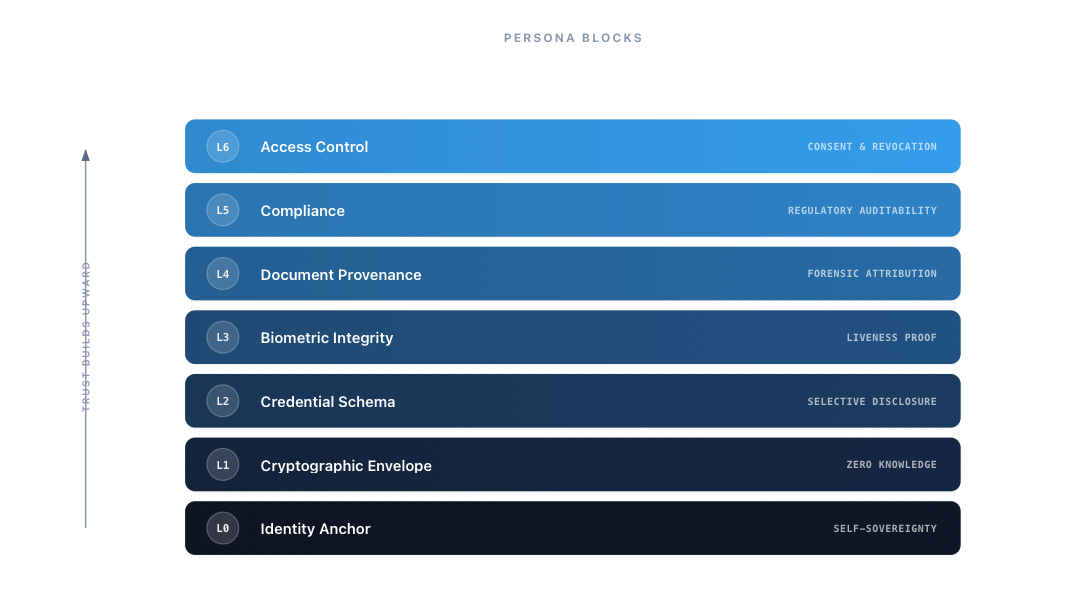
Trust Stack Diagram
Zero-Knowledge Storage

Your wallet is the key

A wallet signature derives a secp256k1 keypair. All 8 document types are encrypted with your public key before touching IPFS. The server never holds plaintext — a compromise yields only encrypted blobs.
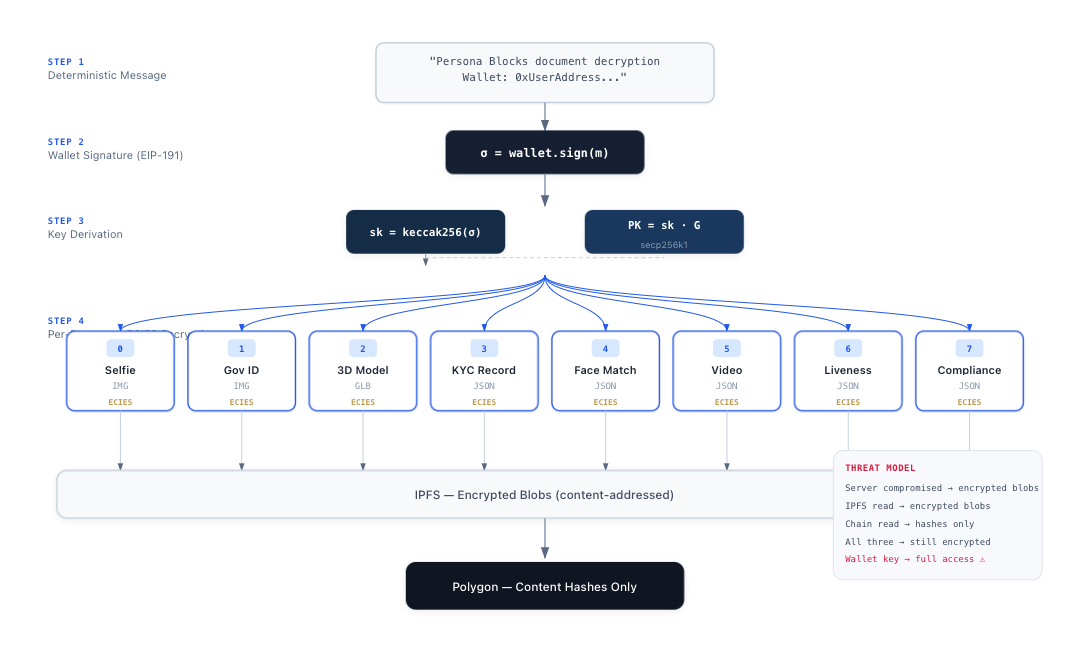
Cryptographic Envelope
Biometric Integrity

3D geometry defeats deepfakes

Three independent biometric streams run in parallel. Each produces an encrypted credential stored in the VIC. Verifiers request only the proof level they need.
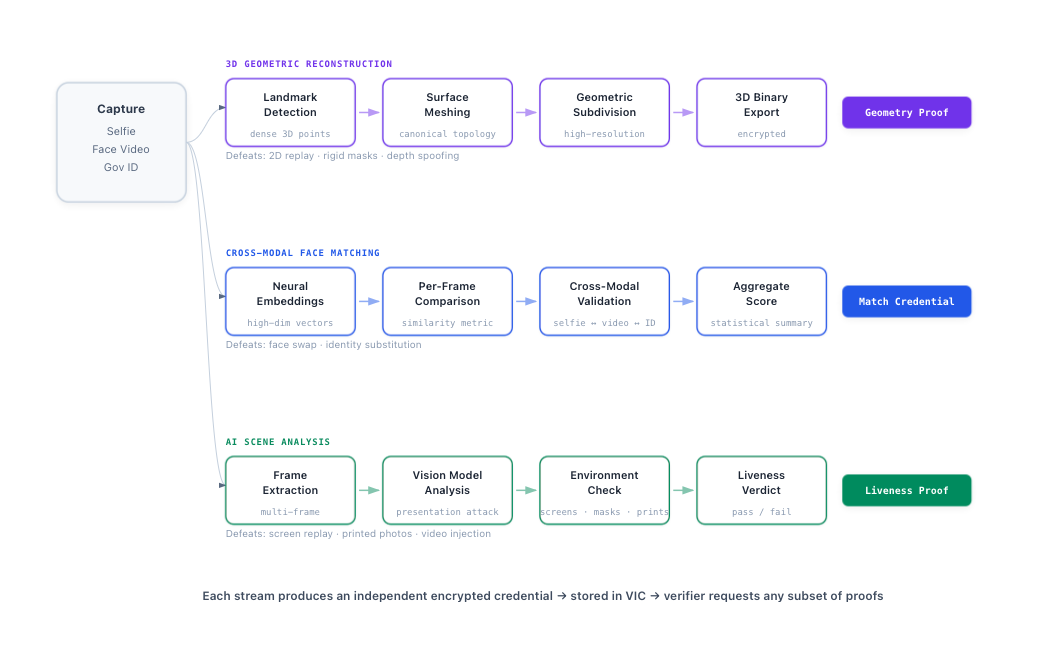
Biometric Pipeline
3D Geometry
Defeats flat replay, masks, deepfakes
ArcFace Neural Match
Selfie ↔ Video ↔ Gov ID cross-validation
AI Scene Analysis
Environment, presentation attack detection
The Credential

The Verifiable Identity Certificate (VIC)

A composable, on-chain credential. Merchants request only the document types they need. The user approves per-attribute access. Revocation is a single transaction.
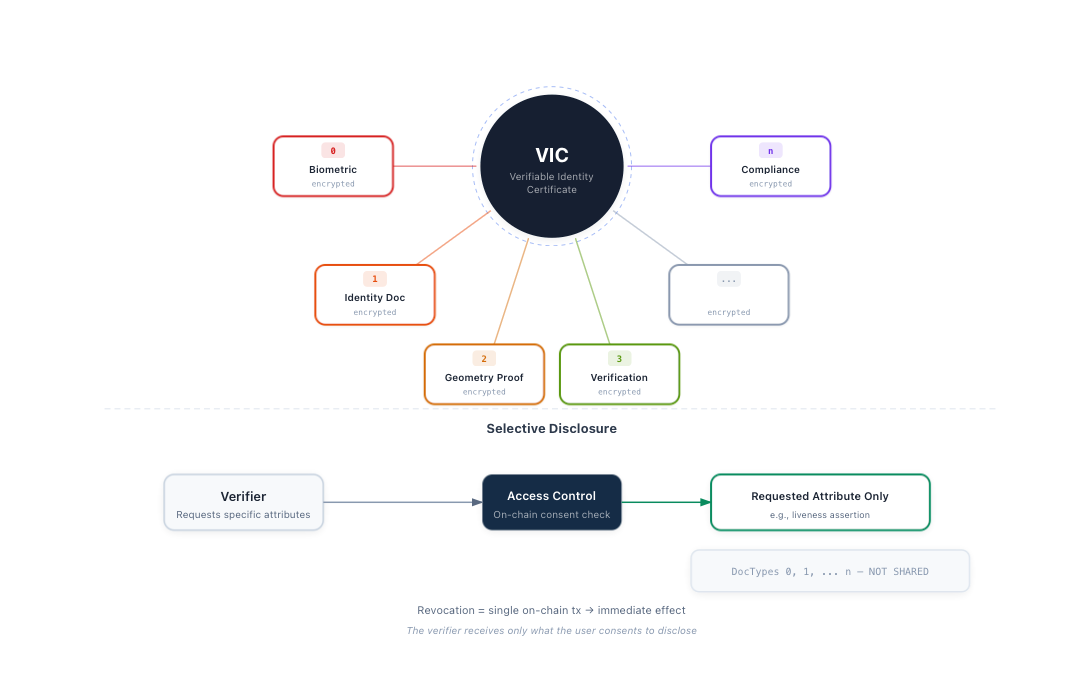
VIC Credential Schema
Compliance by Design

Sovereign ≠ Unregulated

On-chain access control + BSA/AML compliance built in from day one. Multisig required for any document release. Immutable audit trail on Polygon.
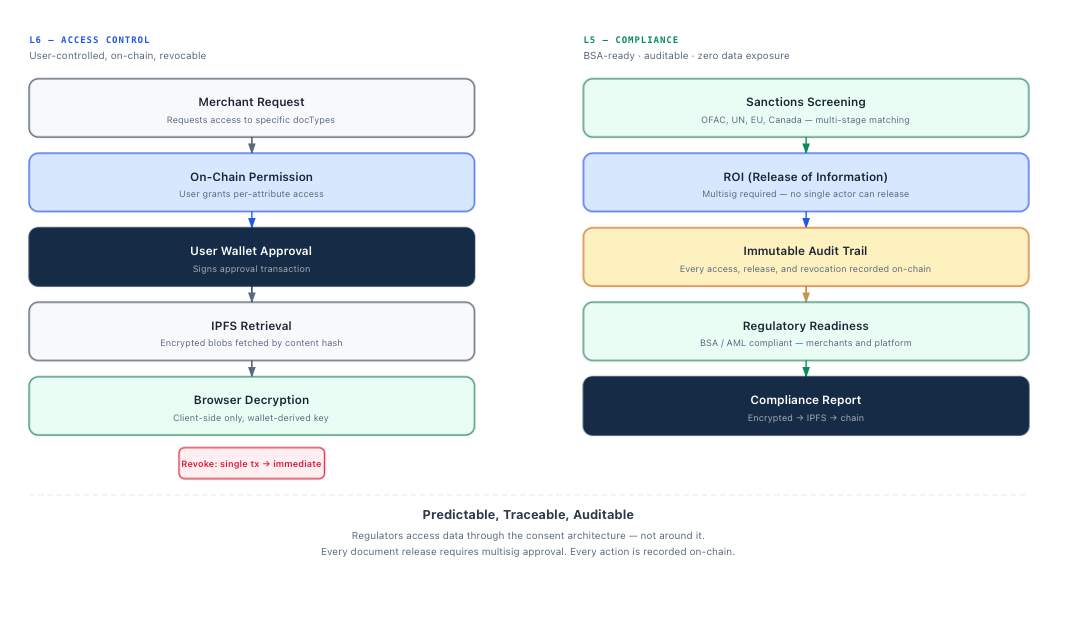
Access Control & Compliance
Forensic Provenance

If a document leaks, we know who leaked it

The Meredith Marks algorithm embeds cryptographic invisible watermarks at every stage of a document's lifecycle. Survives JPEG compression, arbitrary cropping, format conversion, and screenshots.
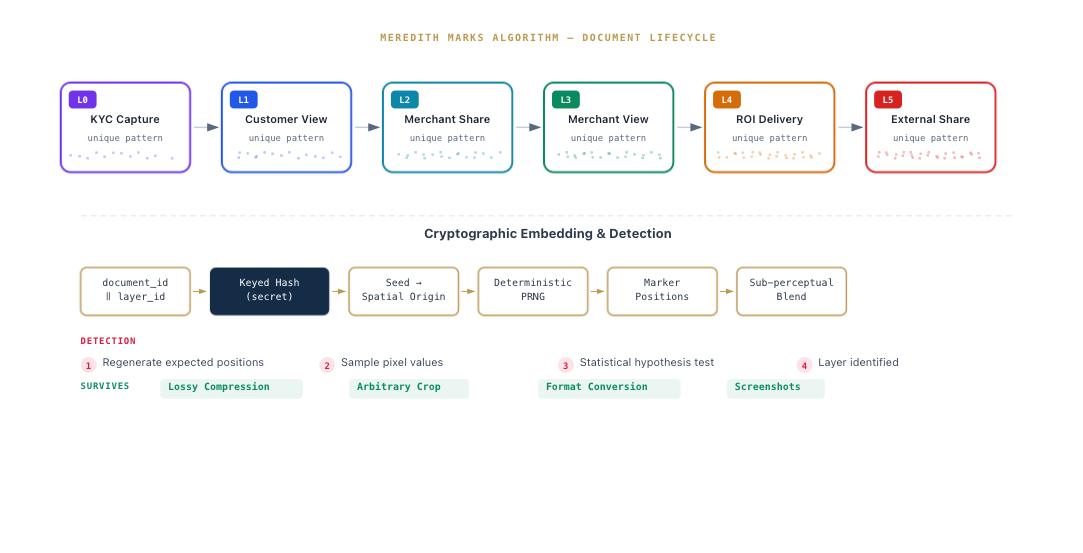
Meredith Marks Algorithm
Market Opportunity

A $206B market ready
for structural disruption

KYC / Identity Verification $18B (2026)
AML / Financial Compliance $206B annually
Digital Identity (SSI TAM) $70B+ by 2030
SAM — Serviceable
$3.8B
Crypto-native fintechs, DeFi protocols, neobanks requiring KYC
SOM — Obtainable (3yr)
$380M
~10,000 merchants × $3,200 ARR avg

Regulatory tailwinds expanding SAM

eIDAS 2.0 · EU 2027

Digital identity wallets mandatory for all 450M EU citizens. Selective disclosure required. Direct alignment with VIC architecture.

Utah S.B. 275 · USA 2026

First U.S. state sovereign digital identity law. Device-based credentials, no surveillance. Model for other states to follow.

ISO 18013-5 mDL · 30+ US airports

Mobile driver's licenses with selective disclosure already accepted at TSA. Infrastructure proven. Market primed.

Business Model

B2B SaaS + per-verification fees

Merchants pay to access verified users. Users pay once for a lifetime portable credential. The platform earns on volume, not on storing your data.

🚀
Starter
$199 / mo
  • Up to 200 verifications/mo
  • Sanctions screening (OFAC, UN, EU)
  • Basic compliance report
  • Merchant portal
🏦
Growth
$799 / mo
  • Up to 2,000 verifications/mo
  • Full biometric proofs (3D, ArcFace)
  • SAR filing automation
  • ROI release workflow
  • Webhook + API access
🏛️
Enterprise
Custom
  • Unlimited verifications
  • White-label + custom chain
  • Dedicated compliance support
  • On-prem / private IPFS
  • SLA + audit support
$2–5
Per verification (vs $30–300 today)
0
PII storage liability for merchants
<60s
Full KYC verification time
Traction

Shipping, not presenting.

⛓️

Live on Polygon Amoy

Full KYC flow deployed at dev.personablocks.io. VICs minted on-chain. Smart contracts deployed.

🧠

3D Biometric Pipeline

MediaPipe 3D face reconstruction + ArcFace cross-modal matching + Claude AI scene analysis — all running in production.

🔏

Meredith Marks Deployed

6-layer cryptographic watermarking. Survives JPEG Q50, arbitrary crops, screenshots. Forensic attribution live.

🛡️

Sanctions Screening

30,951 entries — OFAC, UN, EU, Canada. Multi-stage Jaro-Winkler matching. Auto-SAR at ≥0.85 score.

🏦

Compliance Stack

BSA/AML ready. Multisig ROI workflow. SAR auto-generation (BSA XML 2.0). Full audit trail on-chain.

📄

Academic Backing

"Beyond KYC Theater" — peer-reviewed white paper from Yale SOM. Cited Utah S.B. 275 as the legislative inflection point.

🏗️

What's next

Polygon mainnet launch → first 10 paying merchants → Plaid Link integration → cross-credential ZK proofs → ISO 18013-5 mDL interoperability

The Team

Built by a founder who
understands both worlds.

M

Morris Mwanga

Founder & CEO · Yale School of Management

Graduate student at Yale SOM studying the intersection of financial regulation and decentralized infrastructure. Built Persona Blocks from the ground up — smart contracts, biometric pipeline, compliance stack, and forensic watermarking. Author of "Beyond KYC Theater: Why Self-Sovereign Identity Is Infrastructure, Not Ideology."

Previously, Morris was pivotal in launching the Sand Dollar — the Central Bank of The Bahamas' CBDC and the world's first live retail CBDC. As Architect of the Sand Dollar Ecosystem, he designed the government platform for collecting and disbursing payments in digital currency. He is also a US patent holder (US11403629B2).

🔬
Deep Technical Execution
Smart contracts, biometrics,
ZK-adjacent crypto, compliance infra
📜
Regulatory Fluency
BSA/AML, OFAC sanctions,
Utah S.B. 275, eIDAS 2.0
🌍
Mission-Driven
850M unbanked as a real market,
not a footnote

Hiring: Full-stack engineer with Web3 experience · Compliance / legal counsel · Biz dev (fintech, neobanks, DeFi)

Raising · Pre-Seed Round

$450K to reach
product-market fit

40% — Engineering

1 full-stack/Web3 engineer. Mainnet deployment, mobile-ready SDK, first design-partner integrations.

30% — GTM

Founder-led BD. Land 3–5 design partners in crypto-native fintech and DeFi protocols requiring KYC.

30% — Compliance + Ops

Legal entity setup, initial FinCEN registration, and regulatory framework across target jurisdictions.

The next time someone uploads their passport to a website, they should own it.

The technology exists. The regulation is moving. The breach-cost math is undeniable.

Live Platform
dev.personablocks.io
Founder
Morris Mwanga · Yale SOM
White Paper
"Beyond KYC Theater"